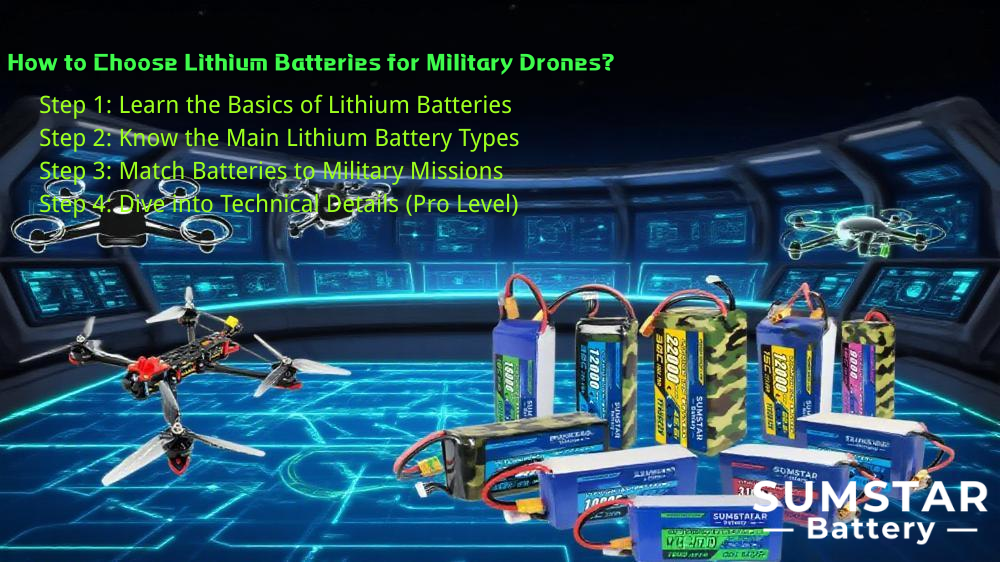
Let’s break down how to choose lithium batteries for military drones, starting from the basics and moving into more technical details. As a new graduate, this step-by-step guide will help you build a clear understanding—no prior expertise required.
First: Understand the “Why”—Military vs. Civilian Drones
Before diving into batteries, let’s clarify why military drones need special lithium batteries.
Civilian drones (for photography or farming) prioritize things like cost, flight time, and portability. But military drones are built for missions like surveillance, combat, or communication relay. Their batteries must meet far stricter demands:
- Work in extreme environments (from -40°C deserts to 60°C jungles, plus dust, saltwater, and vibrations).
- Never fail mid-mission (e.g., losing power during a surveillance run or lacking speed in combat).
- Be ultra-safe (no fires or explosions, especially if carrying weapons or sensitive gear).
Step 1: Learn the Basics of Lithium Batteries
All lithium batteries share core specs—master these first:
1. Voltage (V)
Think of this as the “power strength.” Drones need a specific voltage to run their motors. For example, small multirotors might use 12-24V, while larger fixed-wings could need 48V+.
- Military focus: Voltage stability. When the drone accelerates or carries heavy loads, voltage shouldn’t drop suddenly (this could cause crashes).
2. Capacity (mAh or Ah)
Measures how much energy the battery stores (like a fuel tank). A 5000mAh battery holds more energy than a 3000mAh one, so it lasts longer.
- Military focus: Real-world capacity. Civilian batteries lose 30%+ capacity in cold weather, but military ones need to keep 80%+ even at -30°C.
3. C-Rating (Discharge Rate)
How fast the battery can release energy. A “20C” rating on a 5Ah battery means it can output 5Ah × 20C = 100A of current—critical for quick acceleration or climbing.
- Military focus: Sustained high discharge. Combat drones might need 30C+ for 5-10 minutes straight without overheating.
Step 2: Know the Main Lithium Battery Types
Not all lithium batteries are the same. Here are the 3 most common types for military use, with their pros, cons, and best uses:
| Battery Type | Key Traits (vs. Civilian) | Best for Military Missions |
|---|---|---|
| Lithium-Polymer (LiPo) | High energy density (stores more energy), high C-ratings (great for speed), but poor cold performance and short lifespan (200-300 cycles). | Short, high-maneuver missions: Small attack drones, target drones, or quick recon runs. |
| Lithium-Ion (Li-ion) | Includes NMC (high energy density but less safe in heat) and LFP (lithium iron phosphate: extremely safe—resists fires/explosions, 500-1000 cycles, but lower energy density). | LFP is ideal for long, low-risk missions: Surveillance drones, communication relays. |
| High-Voltage LiPo (LiHV) | 3.8V per cell (vs. 3.7V for standard LiPo), storing 10-15% more energy in the same size. Requires special chargers. | Small, weight-sensitive drones: Hand-launched scout drones carried by soldiers. |
Step 3: Match Batteries to Military Missions
Missions dictate battery needs. Let’s break down 3 common scenarios:
1. Surveillance/Recon Drones (e.g., large long-endurance models like the Rainbow-4)
Needs: Long flight time (12+ hours), light weight, and reliability (no mid-mission failures).
- Best battery: LFP (LiFePO4) or NMC Li-ion with high energy density (250-350 Wh/kg).
- Bonus features: A smart BMS (Battery Management System) to monitor voltage/temperature, heat the battery in cold weather, and prevent overcharging.
2. Attack/Combat Drones (e.g., small armed multirotors)
Needs: Explosive power (for quick evasion or targeting), shock resistance (survive minor impacts), and fast charging.
- Best battery: High-C LiPo (30-50C) or reinforced LFP (balances safety and power).
- Must-haves: A rugged casing (metal or flame-retardant plastic) to resist bullet fragments; cooling systems (fans or heat sinks) to handle high discharge heat.
3. Extreme Environment Drones (e.g., desert, Arctic, or maritime missions)
Needs: Survival in harsh conditions (cold, salt spray, dust, vibrations).
- Key specs: Batteries with low-temperature electrolytes (work at -40°C), corrosion-resistant casings (stainless steel or anti-salt coatings), and passed MIL-STD-810 tests (military standards for temperature, vibration, and salt spray).
Step 4: Dive into Technical Details (Pro Level)
Once you grasp the basics, these advanced factors make or break a military battery:
1. Chemistry: It’s Not About “Best”—It’s About “Fit”
- NMC (Nickel Manganese Cobalt): High energy density (great for long flights) but risky in extreme heat (can overheat). Use for low-risk recon.
- LFP (Lithium Iron Phosphate): Near-indestructible (resists punctures, fires, and overcharging) with long lifespans. Perfect for combat or high-risk missions.
- Solid-State Batteries (Next-Gen): No liquid electrolyte (no leaks!), better at high temps, but expensive. Currently tested in small military drones.
2. Battery Packs: Series, Parallel, and Consistency
Military drones use battery packs (multiple cells wired together), not single cells. Two critical factors:
- Series/Parallel Wiring: Series increases voltage (e.g., 13 cells × 3.7V = 48V for motors); parallel increases capacity (e.g., 2 cells × 5Ah = 10Ah for longer flight).
- Cell Consistency: All cells in a pack must have nearly identical voltage, capacity, and resistance (differences ≤1% for military use). A weak cell can crash the whole pack.
3. Safety: Overengineering Saves Lives
Military batteries can’t fail catastrophically. Key safety features:
- Flame-retardant electrolytes and casings.
- Built-in fuses to cut power during short circuits.
- Drone-integrated fire suppression (e.g., small inert gas canisters in the battery compartment).
4. Logistics: Charging and Storage for the Battlefield
- Fast Charging: Military batteries need to recharge in 1 hour (vs. 2-3 hours for civilian) using field-friendly gear (solar panels, vehicle chargers).
- Long-Term Storage: They must lose ≤5% capacity per month in storage (civilian lose 10-20%). Store at 30-50% charge in cool, dry bunkers.
Final Cheat Sheet for Beginners
- Define the mission: Surveillance (long life) → LFP/NMC; combat (power) → high-C LiPo; extreme environments → MIL-STD-tested batteries.
- Check key specs: Energy density (for life), C-rating (for power), and temperature range (for environment).
- Prioritize reliability over cost: A $1,000 battery that works in a sandstorm is better than a $100 one that fails.
Start with these basics, and as you work with real drones, you’ll learn to balance specs, mission needs, and field conditions. Military battery selection is all about “can it survive and perform when it matters most”—that’s your north star.
If you have any questions or need supports about battery choosing, please contact me.
My WhatsApp: + 86 190 4262 3230